Trace circuits
Identify neurons and synapses involved in sensing, learning, recall and behavior.
 ForgetAlzheimers.net
Scientists have mapped the complete brain and central nervous system of an adult male fruit fly. Explore the full spatial dataset, individual neuron morphology and strong modeled connections—then follow the careful path from a wiring diagram to useful Alzheimer’s research.
Explore the complete real model
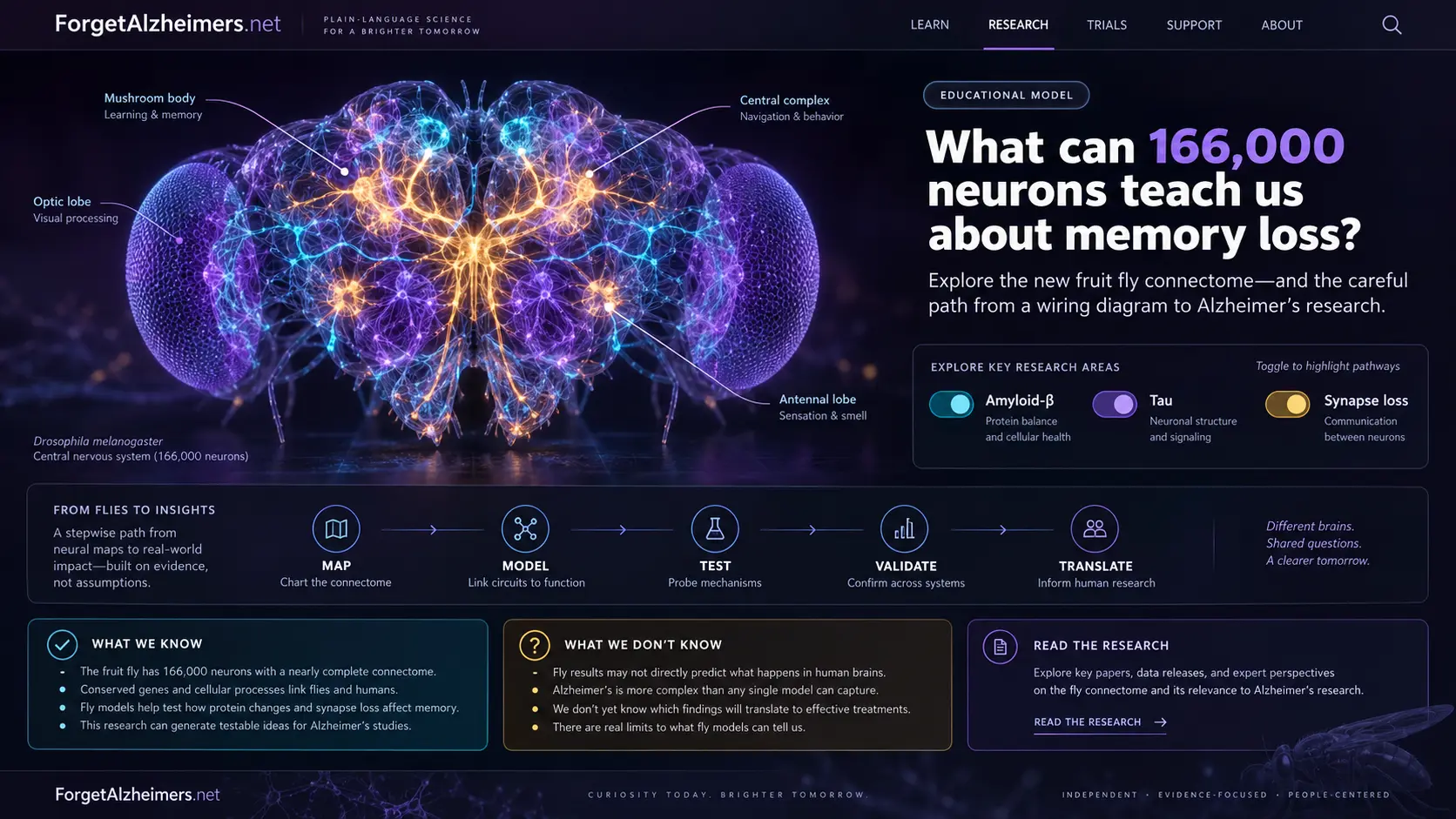
The connectome can help researchers choose better experiments. It cannot by itself reproduce Alzheimer’s, predict a treatment or show how a living network changes over time.
Identify neurons and synapses involved in sensing, learning, recall and behavior.
Introduce amyloid, tau or gene changes in selected cell types in living flies.
Observe memory, neural function, lifespan and structural changes.
Retest promising mechanisms in human cells, organoids and mammalian models.
Use confirmed findings to sharpen human studies—not skip the required steps.
Fruit flies can learn, remember and lose learned associations. That makes them useful for asking focused questions about memory circuits—quickly, measurably and at a scale that is impossible in people.
Map a memory circuit.
Change one variable.
Measure what changes.
Editorial status: This page is a sourced educational explainer and has not been medically reviewed. It does not provide diagnosis, treatment advice or a claim that fruit-fly research will lead to a cure.